
A generational transition has taken place at KONTAKT–Elektro Ltd. in Pécs. Ferenc Hirth, the company’s founder, has passed the baton to his two sons, Olivér and Markus. Olivér’s wife, Orsolya, now works alongside them in the family business.
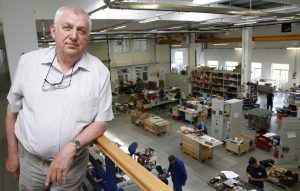
The design, manufacture, and on-site installation of devices and equipment necessary for the electrical automation of industrial facilities and machinery require significant technical expertise. Research and development, as well as innovation, play a key role in their activities; for nearly two decades, they have been engaged in hydrogen technologies and the development of fuel cell applications. To this end, they have placed great emphasis on student training for decades. In collaboration with the Chamber of Commerce and vocational training institutions, they play a significant role in career guidance, promoting professions related to high-voltage electricity, and training specialists.
“Ever since they were in elementary school—Olivér and Markus—they spent their summer breaks at the company,” says Ferenc Hirth, explaining how the relationship between his sons and the company began. “We didn’t have any grandparents nearby, which is why this arrangement came about.”
“When it came time to choose a career path, I first trained as an electrician at the Károly Zipernowsky Technical High School, then earned a degree in electrical engineering from the Mihály Pollack Technical College.” In the 2000s, I spent three-quarters of a year in Germany on an Erasmus scholarship, where I experienced how a market economy works, but I also saw how companies and universities collaborate to ensure a steady supply of skilled professionals. “A focus on development and innovation has always been present at our company; we’re not a traditional manufacturing firm—we have 40 engineers working here,” emphasizes Olivér Hirth.
“We had plenty of time to prepare for the generational transition; Olivér joined the company full-time in 2002, but even as a college student, he was already regularly involved in its day-to-day operations,” says Ferenc Hirth.
“As a recent engineering graduate, I started out in the workshop to familiarize myself with our operations,” Olivér Hirth continues. “I worked there for a year and a half to two years, then moved on to a technical preparation role. Then I learned the ropes in sales, later became sales manager, and after working my way through every department, I became managing director alongside my father in 2010.
As he says, he gradually took over the management of the company; in the early days, they discussed matters related to decision-making. For the past seven years, however, the final decision has been entirely his. During our conversation, it also became clear that they, like other companies, face challenges in recruiting new skilled workers. They are trying to find a solution in two ways: one is through apprenticeship training, which includes both technician and traditional electrician training. They collaborate with the Baranya County SZC József Angster Technical College, Vocational Training School, and Technical School, as well as the Károly Zipernowsky Technical College, and they also accept engineering students for internships. Those arriving for summer internships participate in job interviews and submit their résumés.
Under the guidance of instructors with decades of professional and educational experience, students can acquire the knowledge necessary to practice the electrical trade at a high level using state-of-the-art training panels in a workshop completely separate from production. In addition, they participate in the implementation of two hydrogen-related research and development projects. They can acquire a wide range of knowledge even during their years as students.
“In previous years, we continued to employ four out of every eight of our students,” says Olivér Hirth. “This year, however, no one is staying on.” The reason for this is that our technicians primarily come from the Károly Zipernowsky Technical College; they are mostly talented young people with a good attitude, and they generally go on to further their education. Just recently, one of our students placed second on the “Szakma Sztár” competition, and our two practical instructors, József Gungl and János Bíró, played a major role in this. It’s also a tradition here that, after passing their exams, the practical instructors and students get together for a small outdoor cookout at the end of the year as a farewell. Many of the alumni still keep in touch with them to this day.
He also mentioned that they recruit engineers through headhunting firms and electricians through job postings. Those who are selected are trained through a mentorship program before being placed in real-world situations. Among them was an electrician intern who was able to work on Tesla’s manufacturing technology even during their training period.
– “Last year, we hired four engineers who integrated into the team very well,” Ferenc Hirth adds at the end of our conversation. “When selecting candidates, it’s always important that they be ambitious and creative, with a drive to constantly discover new things and acquire new knowledge. We’re not a traditional manufacturing company; we’re engaged in a significant amount of development work, and for that, we need skilled workers, technicians, and engineers who possess these qualities.”
Sz. K.
09.07.2026
Source: DDG Magazine